


11/11/2026
When a Film Location Outlives the Show
A television production can occupy a Northern Irish location for years, employ local crews and turn an unfamiliar landscape into somewhere recognised around the world. The difficult stage begins after the final scene has been filmed. Sets lose their production purpose, actors move to other projects and the weekly publicity disappears.
Screen tourism can extend that relationship, but recognition alone does not create a lasting attraction. A location needs interpretation, access and reasons to return after the programme has left the cultural spotlight.
Outdoor filming locations often look surprisingly ordinary without cameras, performers and visual effects. A harbour, forest or stretch of coastline may have represented an imaginary kingdom on screen, yet visitors still need help identifying the exact viewpoint. Guides, reference photographs and discreet information panels reconnect the landscape with the finished production.
Preserved studio sets offer another kind of experience. Costumes, props and production drawings reveal the practical work hidden by the story. Visitors can inspect materials, see how apparently solid buildings were constructed and understand how lighting altered a scene.
Digital entertainment also keeps older material available beside new releases. Catalogues of Royal Reels may contain traditional reel games alongside recent titles with additional features. After an eligible customer registers and funds an account, the site validates the deposit and makes its available games accessible. Selecting a title opens a new session, while each completed round and resulting balance change are recorded by the system.
Northern Ireland developed an unusually strong connection with Game of Thrones during ten years of production. The landscapes attracted fans first, but the tourism offer gradually expanded through trails, exhibitions, themed doors, stained-glass installations and the official studio tour at Linen Mill Studios.
This matters because a single photograph rarely supports a full day trip. A studio exhibition can hold visitors for several hours, while an outdoor location may require only a brief stop. Linking the two encourages longer stays and distributes spending among transport providers, guides, cafés and accommodation businesses.
A durable screen-tourism experience usually needs several elements:
• authentic scenery, sets, costumes or props;
• accurate stories about filming and production work;
• safe access that does not damage the location;
• trained local guides who can provide context;
• nearby food, transport and accommodation;
• changing events that give previous visitors a reason to return.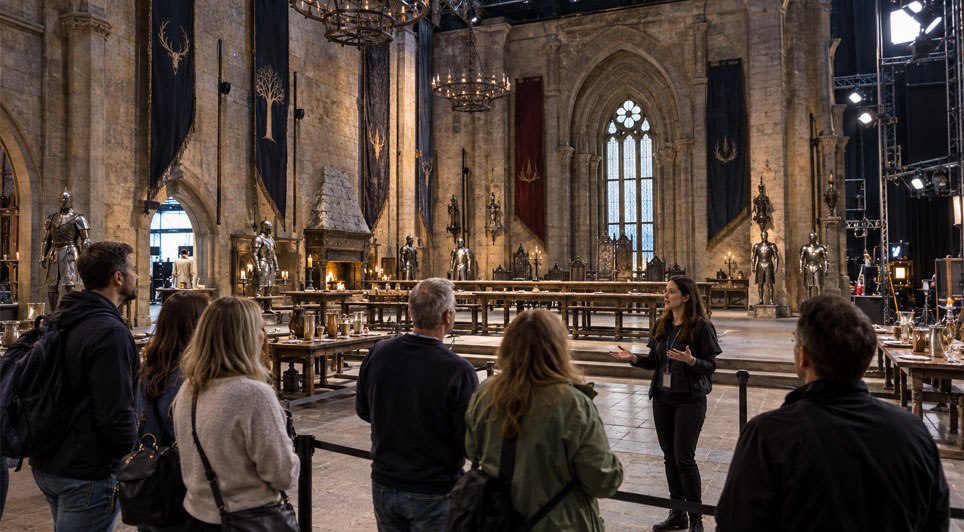 These elements turn recognition into an organised visitor experience. They also prevent a famous location becoming little more than a congested roadside viewpoint.
The strongest tours explain more than which actor stood on a particular rock. They describe how weather interrupted filming, how equipment reached a remote beach and how local craftspeople created objects seen on screen. Such details belong to the location and cannot be reproduced by an exhibition elsewhere.
They also give Northern Ireland’s production workforce a visible place in the story. Scenic construction, costume work, location management and transport are rarely noticed by audiences, although they help explain why major productions can operate in the region.
Tourism NI says screen tourism has become an established part of Northern Ireland’s visitor offer. Its filming-location material connects well-known scenes with coastal and rural sites, including places that previously received little international attention.
Popularity can create problems for the scenery that attracted production companies originally. Narrow roads, limited parking and fragile paths are not designed for repeated coach visits. Private land also remains private even when a recognisable scene appears to invite exploration.
Managed access is therefore part of the product. Timed tours, designated stopping points and clear walking routes can protect residents and landscapes. Guides can also explain where photography is permitted and why certain areas remain closed.
The surrounding place should not disappear behind its screen identity. A coastal village has its own fishing history, architecture and community. Film recognition works best as an introduction that leads visitors towards those wider stories.
Nostalgia can sustain an attraction, but every fan base changes. Younger travellers may know a famous series through clips rather than complete episodes, while returning visitors need more than an unchanged collection of props.
Temporary displays, craft demonstrations and behind-the-scenes tours can renew interest without replacing the original material. Partnerships between visitor attractions and destination organisations also help connect studio tours with Belfast, Banbridge and the wider region.
A production may finish, but its economic afterlife does not have a fixed closing date. The locations that endure are those that preserve genuine material, explain the work behind it and remain interesting even after the final credits have faded.
Screen tourism can extend that relationship, but recognition alone does not create a lasting attraction. A location needs interpretation, access and reasons to return after the programme has left the cultural spotlight.
A Set Cannot Simply Be Left Standing
Outdoor filming locations often look surprisingly ordinary without cameras, performers and visual effects. A harbour, forest or stretch of coastline may have represented an imaginary kingdom on screen, yet visitors still need help identifying the exact viewpoint. Guides, reference photographs and discreet information panels reconnect the landscape with the finished production.
Preserved studio sets offer another kind of experience. Costumes, props and production drawings reveal the practical work hidden by the story. Visitors can inspect materials, see how apparently solid buildings were constructed and understand how lighting altered a scene.
Digital entertainment also keeps older material available beside new releases. Catalogues of Royal Reels may contain traditional reel games alongside recent titles with additional features. After an eligible customer registers and funds an account, the site validates the deposit and makes its available games accessible. Selecting a title opens a new session, while each completed round and resulting balance change are recorded by the system.
The Story Needs More Than One Stop
Northern Ireland developed an unusually strong connection with Game of Thrones during ten years of production. The landscapes attracted fans first, but the tourism offer gradually expanded through trails, exhibitions, themed doors, stained-glass installations and the official studio tour at Linen Mill Studios.
This matters because a single photograph rarely supports a full day trip. A studio exhibition can hold visitors for several hours, while an outdoor location may require only a brief stop. Linking the two encourages longer stays and distributes spending among transport providers, guides, cafés and accommodation businesses.
A durable screen-tourism experience usually needs several elements:
• authentic scenery, sets, costumes or props;
• accurate stories about filming and production work;
• safe access that does not damage the location;
• trained local guides who can provide context;
• nearby food, transport and accommodation;
• changing events that give previous visitors a reason to return.
Local Knowledge Becomes Part of the Attraction
The strongest tours explain more than which actor stood on a particular rock. They describe how weather interrupted filming, how equipment reached a remote beach and how local craftspeople created objects seen on screen. Such details belong to the location and cannot be reproduced by an exhibition elsewhere.
They also give Northern Ireland’s production workforce a visible place in the story. Scenic construction, costume work, location management and transport are rarely noticed by audiences, although they help explain why major productions can operate in the region.
Tourism NI says screen tourism has become an established part of Northern Ireland’s visitor offer. Its filming-location material connects well-known scenes with coastal and rural sites, including places that previously received little international attention.
Outdoor Locations Need Protection
Popularity can create problems for the scenery that attracted production companies originally. Narrow roads, limited parking and fragile paths are not designed for repeated coach visits. Private land also remains private even when a recognisable scene appears to invite exploration.
Managed access is therefore part of the product. Timed tours, designated stopping points and clear walking routes can protect residents and landscapes. Guides can also explain where photography is permitted and why certain areas remain closed.
The surrounding place should not disappear behind its screen identity. A coastal village has its own fishing history, architecture and community. Film recognition works best as an introduction that leads visitors towards those wider stories.
The Next Audience Will Need a New Reason
Nostalgia can sustain an attraction, but every fan base changes. Younger travellers may know a famous series through clips rather than complete episodes, while returning visitors need more than an unchanged collection of props.
Temporary displays, craft demonstrations and behind-the-scenes tours can renew interest without replacing the original material. Partnerships between visitor attractions and destination organisations also help connect studio tours with Belfast, Banbridge and the wider region.
A production may finish, but its economic afterlife does not have a fixed closing date. The locations that endure are those that preserve genuine material, explain the work behind it and remain interesting even after the final credits have faded.
Related Northern Ireland News Stories
Click here for the latest headlines.
17 May 2007
Development Minister opens Valley visitors centre
Regional Development Minister Conor Murphy MP MLA, today officially opened the new Visitors Centre at Silent Valley. Features at the centre include an interactive educational area where visitors’ can learn facts about water conservation and the water cycle and a wildlife sound booth.
07 January 2004
NI TV production companies selected for US visit
Two Northern Irish independent production companies, Brian Waddell Productions Ltd (BWPL) and Extreme Production, have been selected to participate in an international market awareness trip to New York and Washington in February 2004.
NI TV production companies selected for US visit
Two Northern Irish independent production companies, Brian Waddell Productions Ltd (BWPL) and Extreme Production, have been selected to participate in an international market awareness trip to New York and Washington in February 2004.
26 August 2025
Lisburn Production Company Expands With Go Succeed Support
A Lisburn-based video production company, Speed Motion Films, is set to expand after receiving mentoring and funding from the government-backed business support service, Go Succeed. The company, which was established over a decade ago by Damien Gallagher, plans to use the Go Succeed grant to invest in its in-house studio and drone equipment.
10 February 2022
£1.6m Virtual Production Studio Unveiled At Ulster University
A new £1.6 million Virtual Production Studio has been launched at Ulster University by Economy Minister, Gordon Lyons. The state-of-the-art facility is supported by more than £536,000 of funding through the Department for the Economy and will provide teaching of screen industry skills for students at the university.
01 November 2019
BBC Three Scheme Launches For NI Production Firms
BBC Three is inviting independent production companies based in Northern Ireland to submit format ideas as part of a youth content development scheme with the promise of a factual entertainment series for the channel.
BBC Three Scheme Launches For NI Production Firms
BBC Three is inviting independent production companies based in Northern Ireland to submit format ideas as part of a youth content development scheme with the promise of a factual entertainment series for the channel.
-




 Northern Ireland WeatherThis Evening and Tonight:Mostly dry at first with variable cloud and some clear spells, but showers still in the northeast. Further cloud and outbreaks of rain spread northeast overnight. Minimum temperature 5 °C.